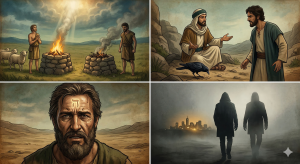

Adam, the first human according to Abrahamic traditions, holds a profound and varied place in the religious imagination of countless people worldwide. His story, though rooted in shared narratives, exhibits remarkable diversity as it’s retold and reinterpreted within different faiths and cultures. Exploring these diverse perspectives on Adam allows us to appreciate the richness and nuance of religious storytelling and understand how the figure of the first man serves as a touchstone for reflecting on humanity’s origins, nature, and relationship with the divine.
The Foundational Narratives: Adam in the Abrahamic Traditions
The core narratives of Adam’s creation and subsequent fall form the cornerstone of the Abrahamic faiths: Judaism, Christianity, and Islam. While sharing fundamental elements, each tradition offers unique emphasis and interpretations that shape their theological understanding of humanity.
1. Judaism: The Primal Man and the Blueprint for Humanity
In the Hebrew Bible (Genesis 1-3), Adam is created “in the image of God” (Imago Dei) from the dust of the ground and given the “breath of life.” He is placed in the Garden of Eden, a paradise where he is to “till and keep” the land and live in harmony with creation and God. The creation of Eve from Adam’s rib emphasizes the original oneness and interconnectedness of humanity.
Key Themes in Jewish Interpretation:
- Imago Dei: The concept of being created in God’s image is paramount in Judaism. It signifies not a physical resemblance, but an inherent dignity, responsibility, and capacity for reason, morality, and spiritual connection with the Divine. Every human being, regardless of background or belief, is seen as carrying this divine spark.
- The Command and the Fall: Adam and Eve are given a single prohibition: not to eat from the tree of knowledge of good and evil. Their subsequent disobedience, often referred to as “The Fall,” represents a fundamental shift in the human condition. It introduces sin, suffering, and mortality into the world, and results in their expulsion from Eden.
- Teshuvah (Repentance): Jewish interpretation emphasizes that while the Fall introduced sin, the possibility of repentance (teshuvah) and reconciliation with God remains central. Humans are not inherently depraved but possess free will and the responsibility to choose righteousness.
- The Role of Adam in Rabbinic Literature (Midrash): Beyond the biblical text, Jewish tradition offers rich commentary on Adam in Midrashic literature. These stories depict Adam in various ways, sometimes as a colossal figure spanning the universe, other times as a righteous leader, and still others as a source of legal precedence. Midrash explores the nature of Adam’s sin, the consequences for humanity, and the relationship between Adam and future generations.
2. Christianity: The First Adam and the Second Adam
Christianity shares the foundational narratives of creation and the Fall but adds a distinct christological lens. The Apostle Paul, in his letters to the Romans and Corinthians, develops the concept of Adam as a type or forerunner of Jesus Christ.
Key Themes in Christian Interpretation:
- Original Sin: This is a crucial doctrine in mainstream Christianity, heavily influenced by Augustine of Hippo. It posits that Adam and Eve’s disobedience resulted in a fundamental corruption of human nature, making all humanity inherently prone to sin and separated from God. This original sin is transmitted from generation to generation.
- The “First Adam” and the “Second Adam”: Paul contrasts Adam with Jesus: “For as by one man’s disobedience many were made sinners, so by the obedience of one man many will be made righteous” (Romans 5:19). Jesus, as the “Second Adam” or “Last Adam,” is seen as overcoming the consequences of the Fall through his sinless life, sacrificial death, and resurrection. He offers salvation and restoration to a right relationship with God.
- The Typological and Prophetic: For Christians, the story of Adam is not just a past event but carries prophetic significance. He is a forerunner whose story foreshadows the redemptive work of Christ. The expulsion from Eden, for example, points toward the need for a savior to restore humanity to paradise.
- The Evolution of Interpretations: Christian perspectives on Adam have evolved over time and vary across denominations. Some modern theologians question the doctrine of original sin, while others embrace an evolutionary understanding of human origins that requires a reinterpretation of the Genesis narrative.
3. Islam: Adam as the First Prophet and a Model for Humanity
In Islam, Adam (Adem in Arabic) is highly revered as the first man and the first prophet. The Quran retells the story of his creation, his habitation in Paradise (often interpreted as a state of being rather than a physical garden on Earth), and his subsequent fall.
Key Themes in Islamic Interpretation:
- Creation and the Breath of Life: Allah (God) creates Adam from clay and breathes into him his spirit (Ruh). The angels are commanded to prostrate before Adam, a sign of his unique status and knowledge, which Iblis (Satan) refuses due to arrogance.
- Knowledge and Caliphate (Vicegerency): Adam is gifted with knowledge, specifically the names of all things, which the angels do not possess. He is appointed as Allah’s caliph, or vicegerent, on Earth, with the responsibility to govern and care for creation in accordance with divine guidance.
- The Test and the Fall: Adam and Eve (Hawa) are warned against approaching a specific tree. Iblis tempts them, leading them to disobey Allah. Their fall results in their descent to Earth and the loss of their initial state of bliss.
- Forgiveness and Guidance: A crucial aspect of the Islamic narrative is Allah’s immediate forgiveness of Adam and Eve upon their genuine repentance. Allah also promises to send guidance (prophets and scriptures) to humanity to help them find their way back to Him. This contrasts sharply with the Christian doctrine of original sin, emphasizing individual responsibility and the availability of divine grace.
- Adam as a Model Prophet: Adam is considered the first in a long line of prophets, including Abraham, Moses, Jesus, and Muhammad. His story serves as a reminder of the perpetual struggle against temptation, the importance of obedience to God, and the necessity of seeking divine guidance.
Beyond the Abrahamic Traditions: Adam in Other Contexts
While Adam is primary associated with Judaism, Christianity, and Islam, his figure and the themes his story represents resonate with other religious and cultural traditions, though often without the same theological framework.
1. Zoroastrianism: Mashya and Mashyana
In ancient Zoroastrian texts, the first human couple, Mashya and Mashyana, emerges from the first plant-man. Similar to the Abrahamic narrative, they are created in purity but are later tempted by Angra Mainyu (the evil spirit) to eat fruit and deny their creator, thus introducing sin and death into the world. While not called “Adam,” their story mirrors the fall of humanity.
2. Gnosticism: Diverse and Complex Interpretations
Gnostic traditions, which developed in the early centuries of the Common Era, often viewed Adam through a highly complex and varied lens. Some Gnostic groups saw Adam as the creation of a lesser demiurge, while others viewed him as a spiritual being trapped in a material body. The figure of Eve often takes on a more central and sometimes redemptive role in Gnostic myths.
3. Manichaeism: Adam as a Cosmic Figure
In Manichaeism, a religion founded by the prophet Mani, Adam plays a significant role in the cosmic struggle between the realms of Light and Darkness. He is depicted as a primordial man who becomes trapped in matter but possesses a spark of divine light. He is given divine revelations and serves as a proto-type for all human beings, who must struggle to free their inner light from darkness.
4. Contemporary and Secular Interpretations
In contemporary society, Adam has also become a cultural symbol and a character in literature, art, and film. He is often explored as an archetype of human nature, innocence, temptation, and the relationship between humanity and the environment. Secular interpretations may use the figure of Adam to explore psychological, social, or philosophical themes without necessarily adopting a religious framework.
Conclusion: Adam, a Mirror for Humanity
The figure of Adam, in all its varied expressions, serves as a mirror reflecting back to us our own interpretations of humanity, God, and the universe. Each tradition highlights distinct aspects of the first man, from his creation “in the image of God” in Judaism to his role as the “First Adam” in Christianity, and his position as the first prophet and vicegerent in Islam.
Despite the theological differences, the universal appeal of Adam lies in his representation of core human experiences: innocence, temptation, choice, consequences, the search for meaning, and the yearning for connection with the divine. Ultimately, the story of Adam, retold and reinterpreted throughout history and across faiths, reminds us of our shared origins, our capacity for both greatness and failure, and our perpetual quest for understanding our place in the cosmos. By engaging with these diverse perspectives, we gain a deeper appreciation for the profound ways in which different cultures and religions have attempted to answer the fundamental questions of human existence.