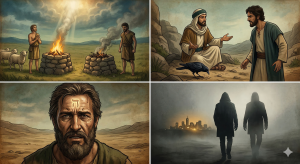
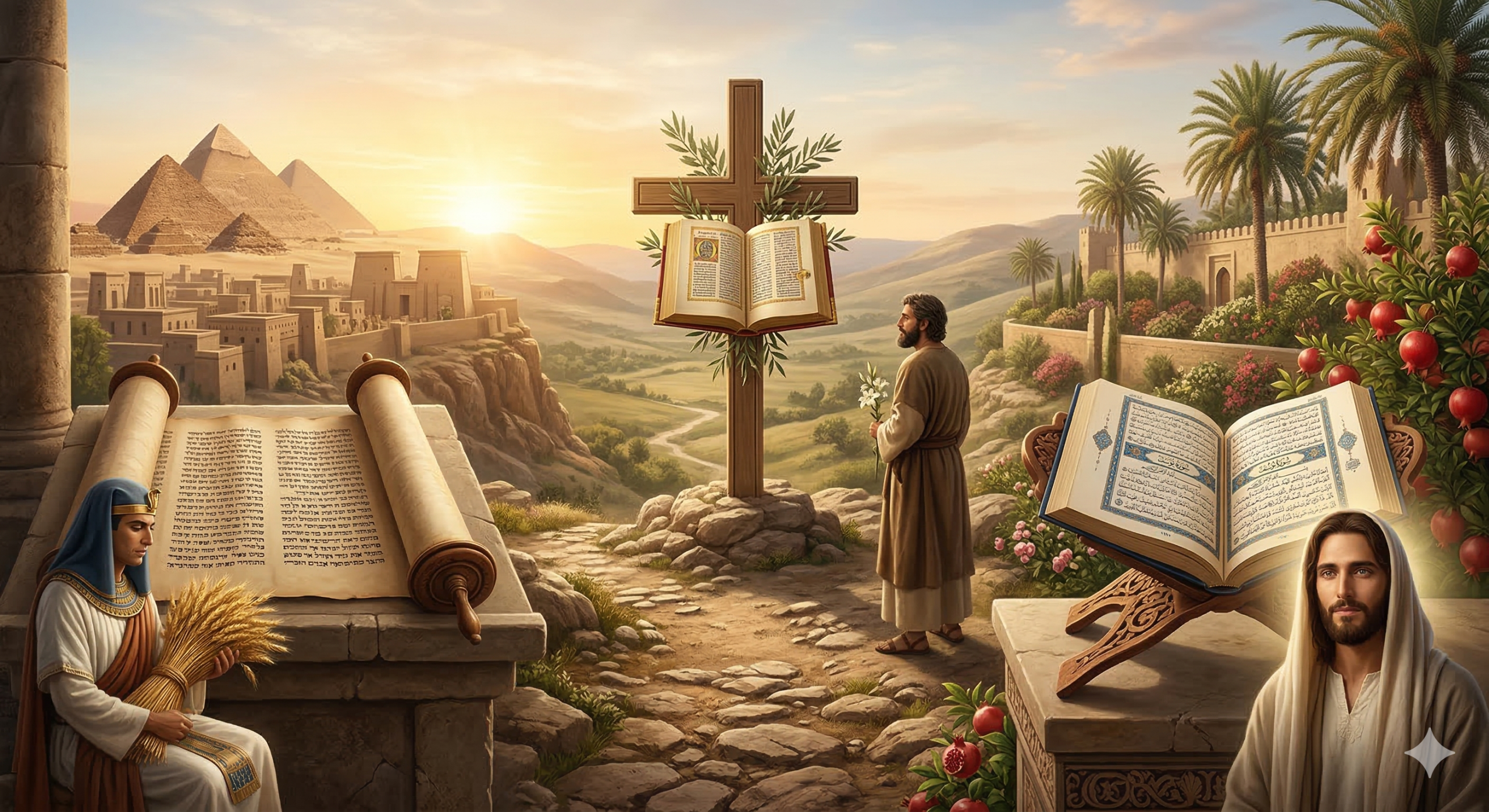
The story of Joseph is one of the most resilient and compelling narratives in human history. It is a tale of favored sons and jealous brothers, of betrayal and enslavement, of supernatural dreams and bureaucratic triumph, and ultimately, of profound forgiveness. It is a story that has transced the dusty scrolls of antiquity to become a cornerstone of faith for billions of people.
But the “Joseph” you know depends entirely on the window through which you view him. To a Jewish person, he is Yosef HaTzadik, the archetype of the righteous Jew in a foreign land. To a Christian, he might be either the Old Testament precursor to Christ or the silent, protective guardian of the Holy Family. To a Muslim, he is Prophet Yusuf, the embodiment of beautiful patience and spiritual wisdom.
By exploring how Joseph is described across different religions, we can uncover not just the nuances of individual faiths, but the shared human virtues that he has come to represent across centuries and continents.
Judaism: Yosef HaTzadik (Joseph the Righteous)
In the Jewish tradition, Joseph’s narrative occupies a vast portion of the Book of Genesis. He is a multi-faceted figure: the beloved firstborn son of Jacob’s favorite wife, Rachel, a dreamer of prophetic visions, and the ultimate administrator who saved Egypt—and his own family—from famine.
The Beloved Son and the Dreamer
The biblical account begins with Joseph as a seventeen-year-old youth, distinguished by his father’s favoritism, symbolized by the famous “coat of many colors” (Genesis 37:3). Jewish commentaries emphasize that this special garment wasn’t just a sign of affection; it was a token of leadership, suggesting Jacob intended Joseph to inherit the spiritual mantle of the family.
His dreams—of wheat sheaves bowing to his sheaf, and of the sun, moon, and stars bowing to him—are not described as mere megalomania, but as authentic prophetic insights. His brothers, however, saw only arrogance, leading to their fateful decision to sell him into slavery.
The Model of Diaspora Integrity
It is in Egypt that Joseph earns his most defining Jewish appellation: Yosef HaTzadik (Joseph the Righteous). This title is most closely tied to his steadfast morality in the face of temptation. When cornered by his master Potiphar’s wife, Joseph refuses her advances not just out of loyalty to his master, but because he would not “sin against God” (Genesis 39:9).
This act is seen as the ultimate example of a Jew maintaining his spiritual identity and integrity while living in the Diaspora—a foreign, often hostile, culture. Jewish tradition paints Joseph as a figure who, despite being surrounded by the paganism of Egypt, never forgot his roots, his faith, or his father’s teachings.
The Practical Messiah
Joseph’s final role in Judaism is that of the supreme administrator and savior. He uses his divine gift of dream interpretation to predict a devastating famine and then uses his administrative genius to structure Egypt’s economy to survive it. He becomes the master of the physical world, all while remaining connected to the spiritual.
In Jewish eschatology (the study of the end times), there is even a concept of Mashiach ben Yosef (Messiah, son of Joseph). This figure is described as a forerunner to the final Messiah, a practical leader who will gather the exiles and fight the initial battles for Israel, a spiritual echo of Joseph, the physical savior of his family.
Christianity: The Precursor, The Father, and The Saint
In Christianity, the name Joseph is associated with two monumental figures: the Joseph of Genesis and the Joseph of the Gospels. Their descriptions are very different, yet they are spiritually intertwined within Christian theology.
Joseph of Genesis: A “Type” of Christ
Christian theologians often interpret the Old Testament through a lens called “typology,” where historical figures are seen as “types” or foreshadowings of Jesus Christ. The Joseph of Genesis is considered one of the clearest types of Christ in the entire Bible.
- Both were beloved sons of their fathers.
- Both were rejected and betrayed by their own people (Joseph by his brothers, Jesus by the Jewish leadership).
- Both were sold for a price of a slave (Joseph for twenty pieces of silver, Jesus for thirty).
- Both descended into a low place (Joseph into a pit and prison, Jesus into death) before being exalted.
- Both became the saviors of those who betrayed them, offering forgiveness and life-sustaining nourishment (Joseph offering bread, Jesus offering the “Bread of Life”).
Through this lens, the Genises Joseph is described not just as a righteous patriarch, but as a living prophecy of the suffering and glorified Savior.
Joseph of Nazareth: The Silent Protector
The Joseph of the New Testament—the husband of Mary and earthly, legal father of Jesus—is described entirely by his actions. Remarkably, the Gospels record not a single word he spoke. He is a “father in the shadows.”
He is first described in the Gospel of Matthew as a “just man” or a “righteous man” (Matthew 1:19). This righteousness is demonstrated when, upon finding Mary pregnant, he resolves to “divorce her quietly” to save her from public shame and the stoning required by Mosaic Law. This shows a man whose faith was tempered by profound mercy.
Following a dream where an angel reveals the child’s divine origin, Joseph’s description is one of absolute, unhesitating obedience. He takes Mary as his wife, he names the child Jesus as commanded, and, most critically, he is told by an angel to flee to Egypt to save the infant from King Herod. This act defines him as the Guardian and Protector of the Holy Family. He is a model of humble fatherhood, a craftsman who provided for his family, and a man whose faith allowed him to trust a path that was humanly terrifying.
Saint Joseph: The Worker and Patron
In Catholic and Orthodox traditions, Joseph of Nazareth is venerated as Saint Joseph. He is regarded as the patron saint of the Universal Church, workers (reflecting his trade as a carpenter), fathers, and a “happy death,” based on the belief that he died in the presence of Jesus and Mary. He is often depicted in art holding lilies, a symbol of his purity and celibate marriage to Mary.
Islam: Prophet Yusuf (Joseph) and the Most Beautiful Story
In Islam, Joseph is known as Prophet Yusuf (PBUH). He is not just a righteous figure; he is one of the most significant prophets mentioned in the Qur’an. While the stories of other prophets are scattered throughout the text, Yusuf’s story is told in its entirety in a single, powerful chapter: Surah Yusuf (Chapter 12). The Qur’an itself calls this narrative “the best” or “the most beautiful of stories.”
The Model of Sabr (Patience and Trust)
Prophet Yusuf is the absolute personification of two core Islamic virtues: Sabr (patience, fortitude, and perseverance) and Tawakkul (complete trust in Allah). From the moment his father tells him not to reveal his prophetic dream to his brothers, Yusuf’s life is a series of severe trials. He is betrayed, sold, falsely accused, and imprisoned for years.
In the Qur’anic version, however, his response is not one of bitterness but of profound faith. After being thrown into the pit, Allah reassures him that he will one day confront his brothers. In prison, rather than sinking into despair, he actively preaches monotheism to his fellow inmates. His final words in the Qur’an are a prayer that he may “die as one who has submitted” (a muslim) and be joined with the righteous. He is a man who saw the hand of Allah in every affliction.
The Integrity and Beauty of the Prophet
Prophet Yusuf’s righteousness in the face of temptation (Chapter 12, verse 24) is also a cornerstone of his description. The Qur’an states that he would have been inclined towards his master’s wife, had he not seen the proof of his Lord. This highlights that his virtue was not effortless but was a result of divine guidance and his own unwavering commitment to purity. He chose prison over the loss of his integrity.
Prophet Yusuf is also universally celebrated in Islamic literature for his exceptional physical beauty. However, this beauty is not described as a purely superficial trait but as a reflection of his inner, spiritual beauty and the light of his prophecy. It was a beauty that inspired wonder, yet it became another test that he passed with humility and grace.
The Wise Administrator
Like the other traditions, Islam describes Yusuf as a wise administrator who saves a nation. However, the Qur’an emphasizes that this wisdom was a direct gift from Allah, “that We might make him the one who can explain the interpretation of dreams” and “whom We gave judgment and knowledge” (Qur’an 12:6, 12:22). His worldly success is seen purely as a manifestation of divine favor and part of a larger, divinely ordered plan.
Conclusion: One Figure, Many Echoes
Though the lens changes from Judaism to Christianity to Islam, the core of Joseph’s character remains incredibly consistent. He is universally described as a man of unshakable integrity, a possessor of supernatural wisdom, and a figure who endured immense suffering without succumbing to bitterness or despair.
- For a Jew, he is the inspiring example of righteousness and success in exile.
- For a Christian, he is the silent guardian and the living promise of the Savior to come.
- For a Muslim, he is the model prophet whose patience and trust in Allah are a “most beautiful” inspiration.
Ultimately, the story of Joseph teaches us that virtues like righteousness, patience, and forgiveness have a language that transcends faith itself. In exploring the many ways he is described, we find that the light of his story shines just as brightly, no matter which window you use to look upon it.