
In the vast tapestry of Abrahamic religions, few figures cast a shadow as long or as multifaceted as Jacob. Known variously as a cunning schemer, a tireless wrestler, and a beloved prophet, his story forms the bedrock of identity for billions. Whether he is the literal ancestor of a nation in Judaism, a forefather of the Messiah in Christianity, or a paragon of patience in Islam, Jacob’s legacy is a testament to the complex, evolving nature of divine chosenness.
This article takes a deep dive into how Jacob is described and revered across the three major Abrahamic faiths, revealing both the threads that bind them and the unique theological colors they apply to his life.
Part 1: Jacob in Judaism (Ya’akov / Israel)
The Third Patriarch, the Father of a Nation
In Judaism, Jacob is not just a historical figure; he is the definitive patriarch whose life story is the story of the Jewish people’s origin. He is the third of the Avot (patriarchs), succeeding his grandfather Abraham and father Isaac. While Abraham represents loving-kindness (Chesed) and Isaac represents disciplined restriction (Gevurah), Jacob is seen as embodying the harmonious balance of both: Truth (Temet).
The Man of the Tents vs. The Hunter
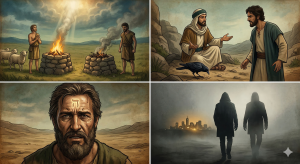
The Torah describes Jacob’s early life through a sharp contrast with his fraternal twin, Esau. Esau is a “cunning hunter, a man of the field,” while Jacob is described as “a plain man, dwelling in tents” (Genesis 25:27). Rabbinic tradition interprets “dwelling in tents” as a metaphor for spiritual study, portraying Jacob as an introverted scholar who valued the eternal over the immediate. This difference is dramatized in the infamous scene where Jacob purchases Esau’s birthright—the spiritual and material leadership of the family—for a simple bowl of lentil stew, illustrating Esau’s disdain for his heritage and Jacob’s deep desire for it.
The Deceiver and the Divine Destiny
Jacob’s character in the early Genesis narrative is complex. With his mother Rebecca’s help, he famously deceives his blind father Isaac to steal the blessing intended for Esau. While this act is ethically challenging, Jewish commentators argue that it was necessary to fulfill the divine prophecy given to Rebecca during her pregnancy: “the elder shall serve the younger” (Genesis 25:23). This highlights a core theme: God’s will can unfold through imperfect human actions.
The Night of Wrestling: Becoming Israel
The single most transformative moment in Jacob’s life occurs at the river Jabbok. Fearing a confrontation with Esau, Jacob sends his family ahead and spends the night alone. There, he wrestles a mysterious “man”—interpreted as an angel or a manifestation of God Himself—until daybreak. Though his hip is inured, Jacob refuses to let the figure go until he receives a blessing. The figure declares, “Thy name shall be called no more Jacob, but Israel: for as a prince hast thou power with God and with men, and hast prevailed” (Genesis 32:28).
“Israel” literally means “One who strives/wrestles with God.” This new name signifies Jacob’s spiritual ascent. He is no longer just “the supplanter” (the folk etymology of Jacob, from the Hebrew word for “heel”), but a champion who fights for divine relationship. This name became the collective identifier for his descendants—the Children of Israel—defining the Jewish people’s ongoing spiritual journey as one of questioning, striving, and maintaining faith.
Part 2: Jacob in Christianity (Jacob)
Forefather of the Messiah and Example of Grace
Christianity inherits the rich narrative of Jacob from the Hebrew Bible, which it includes as the Old Testament. For Christians, Jacob is a pivotal figure in the lineage of faith, but his story is often viewed through the lens of fulfillment in Jesus Christ.
The Lineage of the Promise
The primary significance of Jacob in Christianity is his role in the genealogy of Jesus. The Gospel of Matthew begins with a genealogy tracing Jesus back through King David to Abraham, Isaac, and Jacob: “Abraham was the father of Isaac, Isaac the father of Jacob, and Jacob the father of Judah and his brothers” (Matthew 1:2).
Judah, Jacob’s fourth son, became the forefather of the royal tribe from which the Messiah was prophesied to emerge. Therefore, Jacob is revered as a “patriarch” who, despite his flaws, carried the divine promise that would ultimately blessing “all peoples of the earth” through his descendant, Jesus.
An Illustration of Sovereign Grace
Christian theologians have long grappled with Jacob’s less savory actions, such as his deception of Isaac. Instead of justifying his actions through legalistic interpretations, many Christian traditions use Jacob as a profound illustration of God’s sovereign grace—unmerited favor.
In his letter to the Romans, the Apostle Paul discusses God’s purpose in election, specifically citing Jacob and Esau: “though they were not yet born and had done nothing either good or bad—in order that God’s purpose of election might continue, not because of works but because of him who calls—she was told, ‘The older will serve the younger'” (Romans 9:11-12).
For Christians, this interpretation emphasizes that God chose Jacob not because he was the most moral or deserving, but simply because it was His will. Jacob’s story is thus a comforting reminder that God can use flawed individuals to accomplish His divine purposes.
Part 3: Jacob in Islam (Ya’qub / Israil)
A Prophet of Patience and Monotheistic Legacy
In Islam, Jacob is revered as a major prophet (Nabi) and is mentioned by name 16 times in the Quran, primarily as Ya’qub. He is a link in the “golden chain” of prophets, upheld as a paragon of righteousness and unwavering monotheism.
A Bearer of pure Monotheism (Tawhid)
The Quran presents Jacob as a descendant of Abraham and Isaac, tasked with upholding the pure monotheistic creed of his forefathers. He is described as a model of guidance: “And We blessed him with Isaac ˹as a son˺ and Jacob ˹as a grandson˺, as an additional favour—making all of them righteous. We ˹also˺ made them leaders, guiding by Our command, and inspired them to do good deeds, establish prayer, and pay alms-tax. And they were devoted to Our worship“ (Quran 21:72-73).
Archetype of “Beautiful Patience” (Sabrun Jameel)
While Jacob’s entire life is acknowledged, the Quran places significant emphasis on his role within the story of his son, the Prophet Joseph (Yusuf), detailed in Surah 12.
When Jacob’s older sons, jealous of Joseph, claim that a wolf has devoured him, they present their father with Joseph’s shirt stained with false blood. Jacob, seeing through their lie, utters a phrase that has become a cornerstone of Islamic spirituality: “beautiful patience” (sabrun jameel). He declares, “I complain of my grief and sorrow only to Allah, and I know from Allah what you know not” (Quran 12:86).
In Islam, Jacob represents how a true believer handles profound personal tragedy and family turmoil. His patience is not passive; it is an active turning to God, maintaining hope when all seems lost, and trusting in the divine plan, even amidst extreme suffering.
Confirmatory Legacy on Deathbed
The Quran also recounts Jacob’s final moments, emphasizing his desire to ensure his children die in full submission to God (Islam): “Were you present when death approached Jacob and he said to his sons, ‘What will you worship after me?’ They said, ‘We will worship your God and the God of your fathers, Abraham and Ishmael and Isaac—one God. And we are Muslims [in submission] to Him'” (Quran 2:133).
Conclusion: The Resonant Wrestler
Jacob is a profoundly human patriarch. He is not a static icon of perfection, but a character who grows, struggles, loves deeply, and learns hard lessons.
- In Judaism, he is the wrestler, whose name “Israel” defines the collective spiritual identity of the Jewish people as a people who strive with the divine.
- In Christianity, he is the forefather of grace, a flawed vessel used by God to carry the promise of the Messiah.
- In Islam, he is the prophet of patience, a timeless model of unwavering trust in Allah amidst suffering.
While the descriptions differ, the core of Jacob’s legacy remains consistent: he is a man who refused to let go of God until he received a blessing, and in doing so, he became a blessing to the entire world.