King David is one of the most towering and complex figures in human history. Rising from humble beginnings as a shepherd boy to become the ruler of a united kingdom, his legacy is etched into the very foundations of the world’s major monotheistic faiths. But depending on which sacred text you read—the Hebrew Bible, the New Testament, or the Quran—the portrait of David shifts, highlighting different facets of his character, his relationship with God, and his enduring significance.
In this article, we’ll explore how Judaism, Christianity, and Islam each describe David, revealing a man who was simultaneously a flawed human, a brilliant leader, and a divinely guided instrument.
1. David in Judaism: The Ideal King and Messianic Forefather
For the Jewish people, David (דָּוִד) is the consummate king, the standard against which all subsequent leaders are measured. His story, primarily found in the Books of Samuel and Chronicles, is one of dramatic highs and devastating lows.
The Shepherd and the Giant Slayer
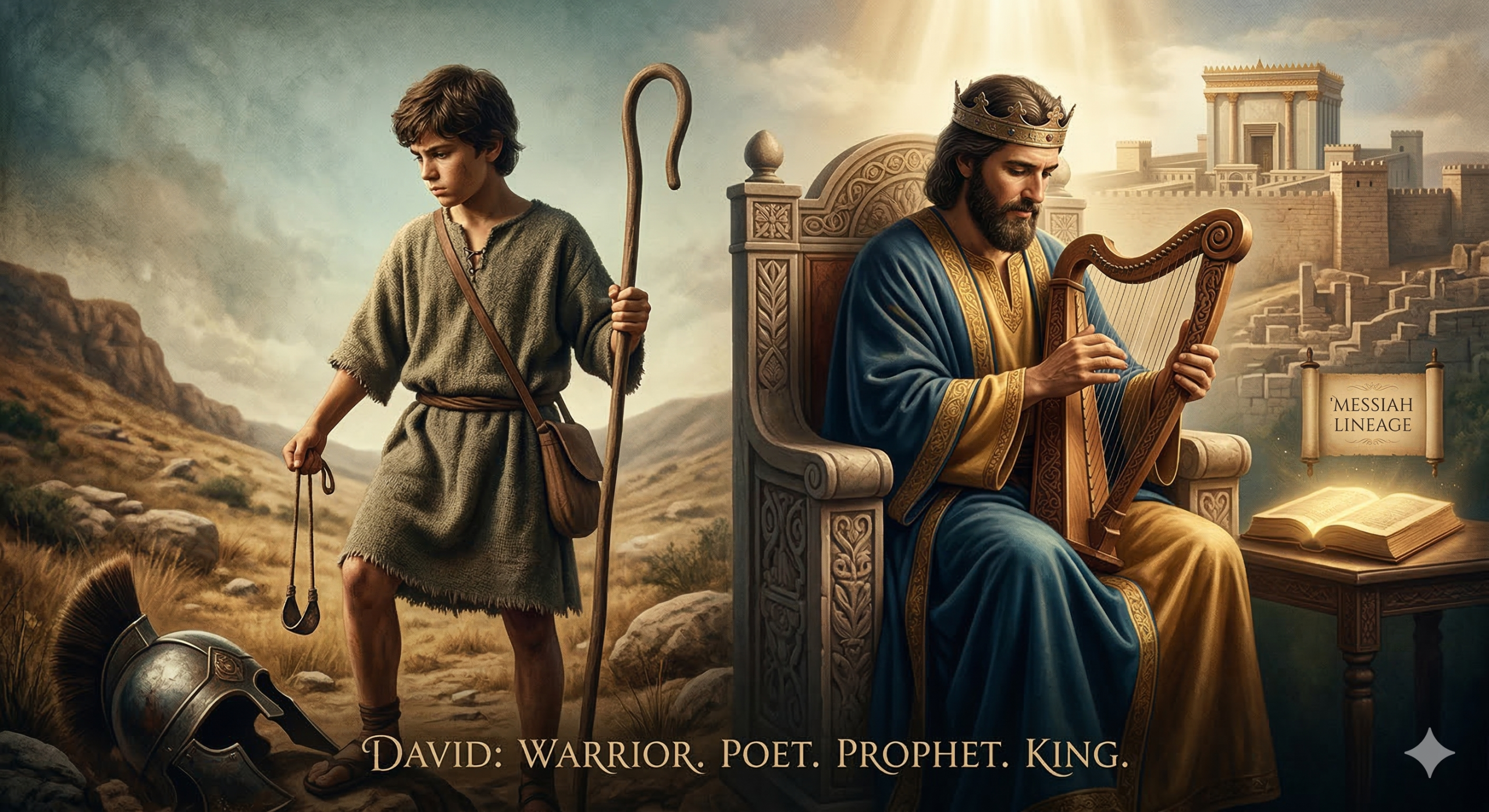
David’s journey begins in Bethlehem, where he is the youngest son of Jesse, a simple shepherd. His unexpected anointing by the prophet Samuel (1 Samuel 16) sets him on a path to kingship, a role he wasn’t born into but was destined for by divine choice.
His first great moment of fame comes with the defeat of Goliath, the towering Philistine warrior. Armed with only a slingshot and unwavering faith in God, David’s victory (1 Samuel 17) is a powerful symbol of faith overcoming brute force and established power. This underdog story is not just a historical event but a moral lesson that resonates throughout Jewish thought.
The Unifier and Builder
As king, David achieved what no one before him could: he united the twelve disparate tribes of Israel into a single, cohesive nation. He established Jerusalem as his capital, a city that would become the spiritual and political heart of the Jewish people. David also laid the groundwork for the First Temple, collecting materials and making plans, though God decreed that his son, Solomon, would be the one to build it.
The Pious Musician
Beyond his military and political achievements, David is revered as a man of deep spirituality. Nearly half of the Book of Psalms is attributed to him, expressing a profound range of human emotions—from exuberant joy and gratitude to deep despair and sincere repentance. His skill as a harpist, which famously soothed the troubled soul of King Saul, is a testament to the powerful connection between music, art, and the divine.
A Man of Flaws and Repentance
The biblical narrative does not whitewash David’s character. His affair with Bathsheba and his orchestration of the death of her husband, Uriah the Hittite (2 Samuel 11), are presented as grievous sins. However, what sets David apart is his sincere and immediate repentance when confronted by the prophet Nathan. His cry, “I have sinned against the LORD” (2 Samuel 12:13), and the penitential psalms that followed (like Psalm 51) make him a powerful model of teshuva (repentance) in Jewish tradition.
The Messianic Promise
Perhaps most significantly, David is the ancestor of the Messiah. Jewish prophetic literature is filled with promises that a future redeemer, who will usher in an era of eternal peace and prosperity, will be a direct descendant of King David. This “Son of David” will restore the golden age of the united monarchy and fulfill God’s covenant with his people. For Jews, David represents both a glorious past and a hope-filled future.
2. David in Christianity: The Anointed One and Precursor to Christ
Christianity inherits and builds upon the Jewish understanding of David, but adds a unique theological layer that connects him directly to Jesus Christ.
The “Man After God’s Own Heart”
The New Testament frequently references David, and perhaps the most famous description comes from the Book of Acts, which calls him a “man after my own heart” (Acts 13:22, quoting 1 Samuel 13:14). This designation emphasizes that despite his many flaws, David’s core desire was to serve and please God. His life serves as a powerful illustration that God can use imperfect people to accomplish his perfect will.
The Son of David
A central tenet of Christian theology is that Jesus is the fulfillment of the messianic prophecies. Two of the four Gospels (Matthew and Luke) provide detailed genealogies tracing Jesus’ lineage back to King David. The title “Son of David” is used frequently throughout the Gospels to identify Jesus as the promised Messiah. The fact that Jesus was born in Bethlehem, the “town of David” (Luke 2:4), is seen as a crucial fulfillment of Old Testament prophecy.
A Model of King, Prophet, and Priest
Christians see David as a “type” or precursor to Jesus in several key roles:
- King: As David ruled over God’s people on earth, Jesus is seen as the King of an eternal, spiritual kingdom.
- Prophet: Christians interpret many of the Psalms attributed to David as prophetic utterances about the life, death, and resurrection of Jesus.
- Priest (in a figurative sense): While David was not technically a priest, his role in establishing the worship system in Jerusalem and his intimate relationship with God are seen as foreshadowing Jesus’ role as the ultimate high priest who mediates between God and humanity.
The Author of Prophetic Psalms
For Christians, the Psalms are not just a collection of hymns but a rich source of christological prophecy. Many psalms are interpreted as speaking about Jesus, such as Psalm 22 (“My God, my God, why have you forsaken me?”) and Psalm 110 (“The LORD says to my lord: ‘Sit at my right hand…'”). David’s words are seen as being divinely inspired to paint a picture of the coming Savior.
3. David in Islam: A Prophet, Messenger, and Just Ruler
In Islam, David is known as Dāwūd (دَاوُد). He is a figure of immense respect and is considered a prophet (nabi) and messenger (rasul) of Allah (God). The Quran mentions him sixteen times, and he is a vital link in the long chain of prophets that preceded Muhammad.
A Divinely Appointed Ruler
The Quran explicitly states that Allah granted David kingship (mulk) and wisdom (hikmah) (Sura 2:251). While other prophets preached during the reign of kings, David was one of the few who was both a prophet and a king. This gave him the unique task of guiding the people of Israel both spiritually and politically, ensuring that the nation remained strong and devoted to Allah.
The Defeater of Goliath (Jalut)
The Quran also recounts David’s youthful victory over Goliath, known in Islam as Jalut (Sura 2:251). This event is presented as a crucial turning point, after which Allah granted him authority and wisdom. David’s military exploits are seen as the act of God, who “drives back some people by others” to prevent the earth from becoming corrupt.
Recipient of the Zabur (Psalms)
A core belief in Islam is the existence of previous revelations. The Quran states that David was given a divine book called the Zabur, which is understood to be the Book of Psalms (Sura 17:55, 4:163). While Muslims believe the original text has been corrupted over time, the existence of the Zabur confirms David’s high rank as a messenger. Allah also bestowed upon him unique miracles, including the ability to soften iron and the mountains and birds joining him in praise.
A Model of Devotion and Justice
Allah frequently mentions David’s high rank as a prophet and messenger in the Quran. He is often mentioned alongside other prophets to emphasize his greatness. A powerful title given to him in the Quran is Khalifa (vicegerent or viceroy) on Earth, a title otherwise only given to Adam (Sura 38:26, 2:30). This suggests a profound role in establishing God’s just rule on earth.
Prophet Muhammad highlighted David’s piety, particularly his unique pattern of fasting. According to a hadith (a saying of the prophet), “The most beloved fasting to Allah is the fasting of David; he would fast one day and not the next.”
Rejection of Biblical Scandals
Crucially, Muslims do not accept the biblical narrative of David’s adultery and murder of Uriah. Islam teaches the doctrine of ismah (sinlessness or infallibility) of the prophets, meaning they do not commit major sins. The story of David in Sura Sad (Sura 38) is seen as a test of his judgment in a dispute, not a confession of major crimes. His request for forgiveness is interpreted as an act of humble piety, not a confession of grave wrongdoing.
Conclusion: A Figure of Enduring Significance
King David remains a complex and powerful figure, a man whose story is told and retold across centuries and faiths.
- For Jews, he is the ideal king and the father of the future Messiah.
- For Christians, he is the “man after God’s own heart” and the ancestor of Jesus Christ.
- For Muslims, he is the divinely appointed Prophet Dāwūd, a model of justice and a recipient of a sacred text.
Despite the differences in interpretation, a common thread runs through all these traditions: David was a man profoundly chosen by God, whose life serves as a timeless example of leadership, faith, creativity, and the power of human connection with the divine. His legacy, enshrined in history, literature, and art, continues to resonate today.